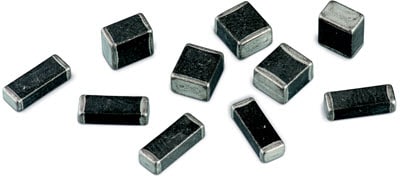
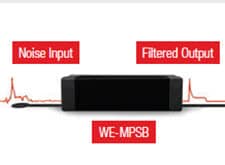
Wurth Electronics WE-MPSB High Current Multilayer Ferrite Beads are the world's first multilayer SMD ferrite beads with clearly specified inrush peak current ratings. Available in a case size range of 0603 to 3312, the WE-MPSB Ferrite Beads from Wurth Electronics consist of different values that are trimmed individually to offer maximum EMI suppression between 100MHz and 1200MHz. WE-MPSB Ferrite Beads also have low RDCs which helps preserve the efficiency of the switching converter circuit. The WE-MPSB series is very cost-effective and offers PCB space savings when compared to a traditional larger filter choke that handles currents from 5-10A.
The WE-MPSB is exposed to all peak current in a general supply network. If the current capability in inappropriate for this application, the component can be destroyed. This component avoids the interruption of the circuit due to peak current handling capability. The WE-MPSB series is a good solution for these short term peak currents (Ip).
Features
Peak current is up to 20-times higher than rated current
Up to 40% higher rated current compared with similar products
Optimized layer design to achieve ultra-low RDC and muscular rated current
High impedance over a wide frequency range at rated current
Minimized DC bias influence to impedance
Available in 0603, 0805, 1206, 1612, 1812, 2220, and 3312 case size
Operating temperature range of -55°C to +125°C
Applications
Transient hostile environments
Filter for inrush current applications
Input/output filter of hot swap controllers
Hot board insertion
Electronic circuit breakers
Industrial high side switch/circuit breakers
Motor interference suppression
Input and output filter for DC/DC converter
WE-MPSB Multilayer Power Suppression Bead
The Innovative Design
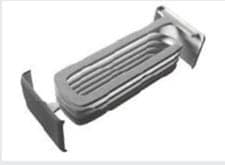
Optimized layer design for muscular peak current capability
Greater trace cross sectional area for ultra-low RDC
High peak current rating to maximize lifetime
WE-MPSB optimizes high-current vs RDC performance with up to 75% RDC reduction in comparison to similar components while maintaining a high impedance over a wide frequency range.
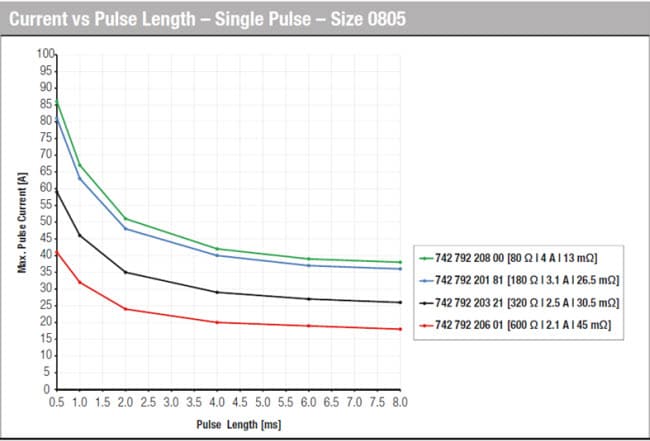
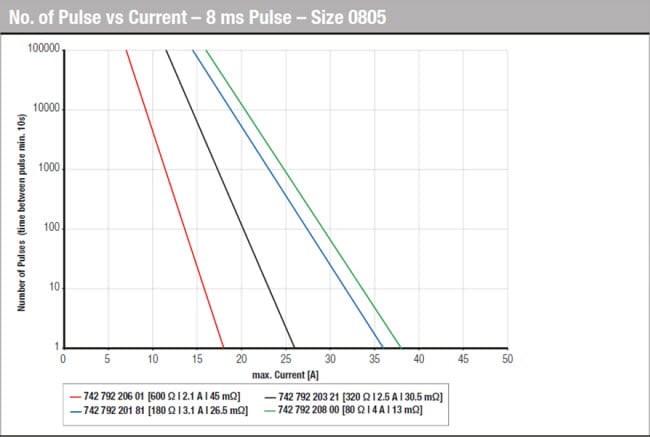
The maximum allowed current varies with pulse length. The chart below shows the maximum allowed current for pulses with a length between 0.5ms and 8ms.
The chart below shows the representation of the relation between maximum number of pulses and pulse current.