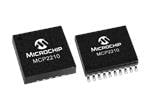

MCP2210-I/SO

Microchip Technology
579-MCP2210ISO
MCP2210-I/SO

Mfr.:

Description:
USB Interface IC USB to SPI Protocol Converter

ECAD Model:
Download the free Library Loader to convert this file for your ECAD Tool. Learn more about the ECAD Model.

In Stock: 1.169

Stock:
1.169 Can Dispatch Immediately
Factory Lead Time:
7 Weeks Estimated factory production time for quantities greater than shown.
Minimum: 1   Multiples: 1
Unit Price:
-,-- kr.
Ext. Price:
-,-- kr.
Est. Tariff:

Pricing (DKK)

Qty. Unit Price
Ext. Price
16,79 kr. 16,79 kr.
12,16 kr. 304,00 kr.
12,09 kr. 1.378,26 kr.
12,01 kr. 3.194,66 kr.
11,94 kr. 6.352,08 kr.

Product Attribute Attribute Value Select Attribute
Microchip
Product Category: USB Interface IC
RoHS:  
USB Controllers
Bridge, USB to SPI
SMD/SMT
SOIC-20
USB 2.0
Full Speed (FS)
12 Mb/s, 480 Mb/s
3.3 V
5.5 V
15 mA
- 40 C
+ 85 C
Tube
Brand: Microchip Technology
Interface Type: SPI, USB
Moisture Sensitive: Yes
Operating Supply Voltage: 3.3 V to 5.5 V
Product Type: USB Interface IC
Factory Pack Quantity: 38
Subcategory: Interface ICs
Unit Weight: 801 mg
Products found:
To show similar products, select at least one checkbox
Select at least one checkbox above to show similar products in this category.
Attributes selected: 0

This functionality requires JavaScript to be enabled.

TARIC:
8542399000
CNHTS:
8542399000
CAHTS:
8542390000
USHTS:
8542390090
JPHTS:
854239099
KRHTS:
8542311000
MXHTS:
8542399999
ECCN:
EAR99

MCP2210 USB-to-SPI Protocol Converter

Microchip MCP2210 USB-to-SPI Protocol Converter is the simplest, smallest, and most cost-effective device for adding USB-certified connectivity to SPI-based systems. This space-constrained Microchip USB-to-SPI protocol converter features nine flexible GPIO pins that can be configured as standard digital I/O pins or in alternate configurations. The MCP2210 converter utilizes the USB HID class supported by Windows®, Linux, and Mac OS® operating systems. This Microchip converter is a 100% plug-and-play solution, making it even simpler to add USB to existing designs for data collection, transfer, and analysis as well as many other USB functions.