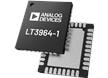


LT3956IUHE#PBF

Analog Devices
584-LT3956IUHE#PBF
LT3956IUHE#PBF

Mfr.:

Description:
LED Lighting Driver ICs 80VIN, 80VOUT Const-C, Const-V Conv

ECAD Model:
Download the free Library Loader to convert this file for your ECAD Tool. Learn more about the ECAD Model.

In Stock: 2.148

Stock:
2.148 Can Dispatch Immediately
Factory Lead Time:
10 Weeks Estimated factory production time for quantities greater than shown.
Minimum: 1   Multiples: 1
Unit Price:
-,-- kr.
Ext. Price:
-,-- kr.
Est. Tariff:

Pricing (DKK)

Qty. Unit Price
Ext. Price
93,18 kr. 93,18 kr.
70,80 kr. 708,00 kr.
67,81 kr. 1.695,25 kr.
59,75 kr. 5.975,00 kr.
56,85 kr. 13.871,40 kr.

Product Attribute Attribute Value Select Attribute
Analog Devices Inc.
Product Category: LED Lighting Driver ICs
RoHS:  
1 Output
Boost, Buck, Buck-Boost, Flyback, SEPIC
3.3 A
QFN-36
80 V
4.5 V
100 kHz to 1 MHz
80 V
LT3956
- 40 C
+ 125 C
PWM Dimming, Open LED Protection
Tube
Brand: Analog Devices
Input Voltage: 4.5 V to 80 V
Mounting Style: SMD/SMT
Number of Channels: 1 Channel
Product: LED Drivers
Product Type: LED Lighting Drivers
Factory Pack Quantity: 61
Subcategory: Driver ICs
Supply Current - Max: 1.7 mA
Type: DC/DC Converter
Products found:
To show similar products, select at least one checkbox
Select at least one checkbox above to show similar products in this category.
Attributes selected: 0

TARIC:
8542399000
CNHTS:
8542399000
CAHTS:
8542390000
USHTS:
8542390090
MXHTS:
8542399999
ECCN:
EAR99

IS32LT3175N/P Single-Channel Linear LED Drivers

ISSI IS32LT3175N/P Single-Channel Linear LED Drivers come with fade in/out and PWM dimming. The regulators serve as a stand-alone LED driver-configurable from 20mA to 150mA with external resistors, no microcontroller is necessary. A logic level “courtesy light” signal from the PWM pin can be interfaced to precisely drive the LED channel. The IS32LT3175P obtains a positive polarity PWM signal. In addition, the IS32LT3175N obtains a negative polarity PWM signal. The regulator integrates a 63-step fade-in and fades out the algorithm (Gamma correction). This causes the output LED current to increasingly rise up to the full source value after the EN pin is pulsed.